
Telemann’s Musique de Table: An Introduction

In this post and the next three I want to share one of my abiding musical passions. Anyone who knows me knows I’m a “Baroque head” from way back, and that JS Bach and Handel have been, as it were, lifelong companions, along with so much more of the music of the 17th and 18th centuries.
Part of this “so much more” is the music of Georg Philipp Telemann. For many, it seems, Telemann’s music is somewhat unapproachable, not because of any complexity it might have (although there’s plenty of that) but simply because there’s so much of it. Telemann is regarded – by most writers I’ve seen – as the most prolific composer who ever lived [the 1998 Guinness Book of World Records lists Telemann in this respect] and a quick look at his worklist in Grove supports this assertion. The numbers beggar belief. Johann Sebastian Bach is known to have written around 200 sacred cantatas; Telemann wrote nearly nine times as many. Grove lists nearly 1,800 sacred cantatas in the Telemann worklist, not to mention secular cantatas and similar vocal works for civic occasions. We have two surviving passions by Bach; Telemann wrote more than fifty.
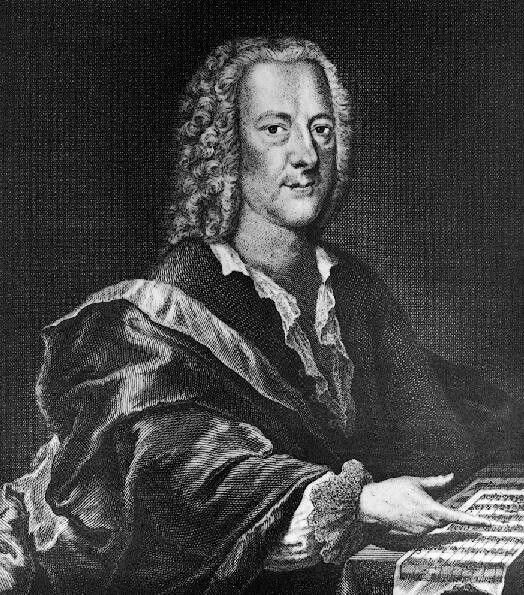
Of course, it can be argued that Bach’s cantatas and passion settings are on the whole longer and more complex than Telemann’s, but still, the man’s capacity for work is undeniable. And the music is good; Telemann needs no excuses made for him.
And that’s just cantatas and passions. Telemann’s other works – orchestral, chamber, solo instrumental, operatic – are counted in the hundreds. His total output is said to number some 3,000 works and the authoritative complete edition of the scores, published by Bärenreiter and begun in 1953, is still in progress with some 60 volumes published and no projected finishing date.
Telemann lived a very long life. He was born in Magdeburg in 1681 and died in Hamburg in 1767 at the age of 86. Consider those dates. He was born four years before Bach and Handel and died when Haydn was 35 and Mozart was 11 (or if you like, three years before the birth of Beethoven).
What’s more, Telemann knew both Bach and Handel personally (fascinating when you consider Bach and Handel never met each other). Telemann was godfather to Bach’s son, Carl Philipp Emanuel; the “Philipp” came from Telemann’s middle name. And Handel and Telemann met as teenagers and maintained contact for decades. Telemann was probably more popular and more widely-known in the early 18th century than either Bach (whose career was very provincial), or Handel (whose career, while more international, was squarely based in London for the last nearly 50 years of his life).
Apart from corresponding on musical matters, Handel and Telemann shared a love of flowers. When Telemann, in his 60s, took an active interest in gardening, Handel sent him a crate of rare English bulbs and tubers.
Telemann’s speed of composing was described by Handel in a famous quote (the source of which I’m struggling to find) in which he said Telemann could write an eight-part motet in the time it would take an ordinary person to write a letter. Considering the speed at which Handel himself could write, that’s saying something.
And Telemann didn’t just compose; composers in the Baroque almost never “just composed”. Bach directed music in churches or secular courts, with all the training and administration that implies. Handel ran the seasons in which he performed. Vivaldi taught at a charitable institution. In his early life Telemann had posts in Leipzig (before Bach’s time there), Sorau (Żary in modern day Poland), Eisenach and Frankfurt before moving to Hamburg in 1721.
It was in Hamburg he established himself as a tireless performer, composer, entrepreneur and publisher. His core position was a director of music for the five main Lutheran churches in the city but he soon became involved in all sorts of other activities, including running the opera theatre for a time. He regularly engraved the plates himself for his many publications and produced vast quantities of music for every conceivable context. He was a leading figure in securing exclusive publication rights for his music, an early step in creating the concept of intellectual property. He also pioneered the then-new concept of public concerts, making music available to a wider audience and providing another stream of income for himself. He stayed in Hamburg for the rest of his life – some 46 years – and on his death his post was taken by his godson, Carl Philipp Emanuel Bach.
The Musique de Table
One of Telemann’s most substantial and delightful creations was published in 1733. It’s an enormous collection of music under the title Musique de Table. This translates literally as “Table Music” or “Music for the Table” and is often known by the German translation of Tafelmusik (a name appropriated by a famous Canadian period instrument orchestra). It seems Tafelmusik is widely assumed to be Telemann’s title for the collection these days, probably because he was German, but I’m going to stick with the French title he used. French was very much the court language across Europe at the time and was often the language of choice in formal or literary settings. In this literal sense it describes music designed for performance during meals, a famous example being the collections of Symphonies pour les soupez du roy (Symphonies for the suppers of the King) by Michel-Richard de Lalande, compiled for Louis XIV early in the 18th century.

However "musique de table" was also used in a more generic sense to simply denote a collection of pieces, whether or not these were intended for meal time entertainment (just as a minuet or sarabande in an instrumental work might not be intended for actual dancing). I feel that Telemann’s use of the term better fits this more general usage as, while some pieces are intimate enough to be genial background music to the chatter of diners and the clatter of cutlery, much of it is far too complex, too “in your face”, to be mere musical wallpaper.
Telemann published the work himself and advertised its impending release. The idea was to solicit subscriptions from well-heeled musicians and music lovers to offset the costs and make a profit. Subscribers didn’t receive a score (publishing a score was very uncommon at the time) but rather a full set of instrumental parts, thus facilitating performance. The cost was eight Reichthaler, which was extremely expensive. Yet such was Telemann’s reputation that more than 200 subscribers forked out the required cash in advance, and were rewarded with their names being printed in the edition.
The subscriber list is fascinating and contains names from all over Europe, including royalty. Among well known composers were Johann Georg Pisandel and Johann Joachim Quantz from Dresden and Michel Blavet from Paris. But perhaps the most famous was one “Mr Hendel, Docteur en Musique, Londres”. Handel’s name was often spelt “Hendel” in his lifetime, even in England, a spelling which reflected the original pronunciation of “Händel” in German. As we shall see, Handel was to get a great deal of use from Telemann’s collection.

I love the Musique de Table and listen to it often in my car on longer drives. Wikipedia lists many recordings of the work although only eight are complete. The two I know best are those directed by Reinhard Goebel with Musica Antiqua Köln (Archiv, 1989, re-released 2010), and by Petra Müllejans and Gottfried von der Goltz with the Freiburg Baroque Orchestra (Harmonia Mundi, 2010). Both are excellent period instrument performances, and both take a touch over four hours on four CDs. Someone has kindly uploaded the Freiburg recording onto YouTube so I’ll link to that in the course of the posts that follow.


Structure
Telemann’s four hours of music is structured into three parts, or “Productions” in the French of the 1733 publication. Within each Production we find orchestral and chamber works in an ever-changing combination of instrumental forces, but each Production follows the same plan:
Ouverture (or suite)
Quartet
Concerto
Trio
Sonata
Conclusion
It seems logical to me that Telemann would never have conceived of the entire collection being played in a single sitting, or even that each Production would be played complete. Each work within each Production is a discrete, stand alone composition, and each is catalogued separately within the vast Telemann compositions catalogue (TWV, or Telemann Werke Verzeichnis), the details of which I discuss below.
What’s more, each Production starts with an orchestral Ouverture or suite, and the key of this suite informs the choice of keys for the other works within that Production. The exception is a single work in each Production which stands apart in terms of key from all the other works. In other words, the keys chosen for each work within a Production somehow relate to the key of the suite, except for one which is in a key quite remote from that of the suite.
Each Production ends with a short virtuoso movement simply called “Conclusion”. This is in the same key – and written for the same instrumental forces – as the suite which opens that Production. This rounds off each Production logically but I can’t help thinking Telemann might have intended this piece to be appended to the end of the suite in performance, but that he printed it at the end to make things look neater. Of course the suite in each case works perfectly fine without adding the Conclusion movement, but there seems to be little rationale for playing the Conclusion on its own; each only lasts a few minutes.
Each of the posts that follow will explore each Production in turn. I hope they provide you with a roadmap for exploring this incredible treasure of Baroque music, a vast repository of brilliant, beautiful music by a man known to and admired by Bach and Handel but whose music is markedly original and always intriguing.
Scores
I don’t have access to a copy of the Bärenreiter Urtext scores of the Musique de Table (which they publish in three volumes as Tafelmusik) but rather will refer to the Max Seiffert edition published in 1927 as part of Denkmäler Deutscher Tonkunst and made available online by IMSLP Petrucci Music Library. I'll provide links for the scores as well.
…..
The TWV Catalogue: Telemann Werke Verzeichnis
Before we explore the three Productions, a word about the ever-present TWV numbers one encounters when discussing Telemann’s music.
The enormous job of cataloguing all of Telemann’s known works – some 3,000 of them – was undertaken by the German musicologist Martin Ruhnke (1921-2004). The catalogue was published in three volumes between 1984 and 1999 and differs from the better-known “WV” catalogues (such as BWV for Bach, or HWV for Handel) in the way it labels each work. Given Telemann’s vast output, Ruhnke’s catalogue divides the music into type or genre and then within genre by key (in the case of the instrumental works), after which, within keys, a work gets a number.
There are 55 genre divisions. For example, TWV1 covers church cantatas, TWV21 covers operas, TWV32 harpsichord suites, TWV51 concertos for one instrument and orchestra, TWV55 orchestral suites, and so on.
After the genre number there’s a colon (:)
Then, in the case of the instrumental works, comes the key. Let’s look at TWV55, the orchestral suites. This section contains some 125 works (yes, 125 orchestral suites!) and these are organised by key in order up the keyboard from C to B natural. It’s vital to remember that German key nomenclature is used, so keys in upper case are major keys while lower case means minor; the words “major” and “minor” are therefor not needed.
In addition, in German, “B” means B flat to English speakers, while “H” means B natural. (I have no idea why; it’s just the way it works in German.)
Furthermore, flat keys (apart from B flat; see above) have “-es” added (or “s” in the case of a vowel), so “Des” means D flat, “Es” means E flat, “As” means A flat, and so on.
And sharp keys have “-is” added. “Cis” is C sharp, “Fis” is F sharp, etc.
So…!
TWV55:C3 refers to an orchestral suite in C major, the third in a list of what turns out to be 7 orchestral suites in that key. The “3” differentiates it from the other six C major suites.
TWV55:c4 refers to an orchestral suite in C minor (note the lower case “c”). There are four C minor suites of which this is the last.
TWV55:Es4 is the fourth in the list of orchestral suites in E flat major.
TWV55:fis1 is an orchestral suite in F sharp minor; the “1” is slightly redundant as there is only one suite in that key (I’ve conducted it!), but perhaps Ruhnke was leaving it open for the possible discovery of another work in that key in the future. Such things happen.
In the case of the larger vocal works like cantatas and oratorios, where single works contain movements in multiple keys, there are just the two numbers and no reference to key. So a church cantata’s listing would be like TWV1:627. The cantatas are arranged alphabetically by the first line of the text. The eight oratorios, which are easier to date because of documented performances, are actually arranged chronologically within TWV6, but this is an exception.
So it will be seen that, as most of Telemann’s works are impossible to date accurately, the TWV catalogue overall (unlike the K/Köchel catalogue for Mozart or the D/Deutsch catalogue for Schubert) makes no attempt to catalogue Telemann’s music chronologically. In cataloguing it by type it aligns with other “WV” catalogues in general use.


Comments